
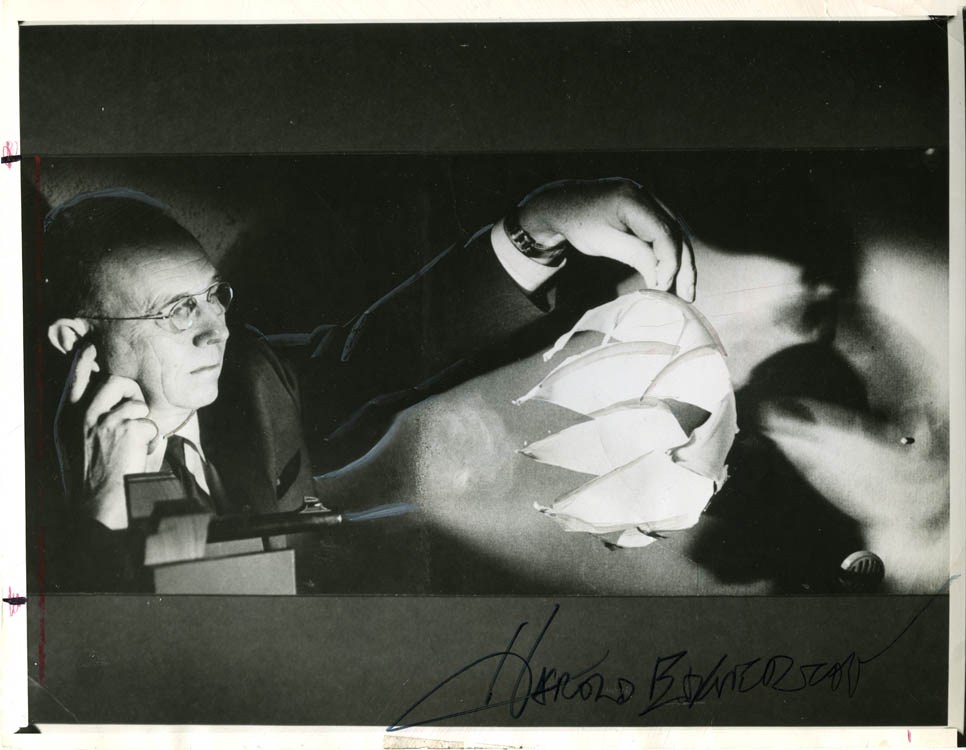
About
Harold Edgerton (1903–1990) was an American engineer and photographer whose invention and refinement of the electronic stroboscope transformed both scientific measurement and the visual language of photography. Born in Fremont, Nebraska, he studied electrical engineering at the University of Nebraska before moving to MIT, where in 1926 he began using the stroboscope to study the rotation of a motor — an inquiry that would define his career.
By 1931 Edgerton had perfected the stroboscope for ultra-high-speed photography, publishing his findings and earning his doctorate the same year. Through the 1930s he produced landmark images of everyday phenomena frozen at speeds no camera had previously captured — a bullet piercing an apple, a drop of milk forming its famous coronet, athletes suspended mid-motion — work that entered both scientific journals and popular magazines and was included in the inaugural photography exhibition at the Museum of Modern Art, selected by Beaumont Newhall in 1937.
In 1934, with two of his students, Edgerton founded the firm Edgerton, Germeshausen and Grier, extending strobe technology toward aerial reconnaissance; his nighttime aerial flash photography was used by the US Air Force in the lead-up to the Normandy invasion. Postwar, he engineered instrumentation for nuclear test photography at Eniwetok Atoll and developed sonar and underwater camera systems for a long collaboration with the oceanographer Jacques-Yves Cousteau, with whom he helped locate the wrecks of the Mary Rose and the HMS Britannic.
Edgerton’s photographs were the subject of museum exhibitions throughout his life, including The Exact Instant at MoMA (1949, curated by Edward Steichen) and Once Invisible, organized by John Szarkowski at MoMA in 1967. He received the US National Medal of Science in 1973 and was inducted into the National Inventors Hall of Fame in 1986. He remained active at MIT, where he was named Institute Professor, until his death in Cambridge, Massachusetts, in 1990.
Education
- 1927Master of Science, Electrical Engineering — Massachusetts Institute of Technology
- 1925B.S., Electrical Engineering — University of Nebraska, Lincoln
Exhibitions
Solo
- 2025
Harold Edgerton — Photographs from the Gerd Sander Collection — Galerie Julian Sander, Cologne
- 1987
Retrospective — International Center of Photography, New York
- 1976
Seeing the Unseen — Victoria and Albert Museum / Science Museum, London
- 1974
Retrospective — Museum of Science, Boston
- 1965
First Solo Exhibition — Museum of Science, Boston
Group
- 2025
Paris Photo — Paris
- 2021
Paris Photo — Paris
- 2020
Brocante: La Maison de Chineur fondée à Cologne en 1940 — Images and Objects from the Gerd Sander Collection — Galerie Julian Sander, Cologne
- 1967
Once Invisible — Museum of Modern Art, New York
- 1949
The Exact Instant — Museum of Modern Art, New York
- 1937
Museum of Modern Art photography inaugural exhibition — Museum of Modern Art, New York
- 1933
Royal Photographic Society Annual Exhibition — London
Publications
- 1979
Moments of Vision (with James R. Killian)
- 1977
Seeing the Unseen: Twelve Photographs by Harold Edgerton (portfolio)
- 1970
Electronic Flash, Strobe
- 1939
Flash! Seeing the Unseen by Ultra-High-Speed Photography (with James R. Killian)
Links
Biographical information based on galeriejuliansander.de and public sources.
Collections
Museum of Modern Art, New York · Victoria and Albert Museum, London · Science Museum, London · George Eastman House, Rochester · MIT Museum · Gerd Sander Collection
Awards & honours
1986 — National Inventors Hall of Fame · 1983 — Eastman Kodak Gold Medal, Society of Motion Picture and Television Engineers · 1981 — Kulturpreis, Deutsche Gesellschaft für Photographie · 1973 — National Medal of Science, awarded by President Richard M. Nixon · 1949 — Joseph A. Sprague Memorial Award, National Press Photographer’s Association · 1946 — Medal of Freedom, US War Department · 1934 — Bronze Medal, Royal Photographic Society